Cloud Native Telecom Certification
Cloud Native Telecom Certification (CNTC) is an open framework that tests open-source telecom network functions against published standards and issues a graded verdict, a scorecard and, on a clean pass, a certificate. The model is the same at every layer: a versioned requirement catalog, automated tests over the real interfaces, an essential-test gate, and a result that can be re-checked by anyone.
What is certified today
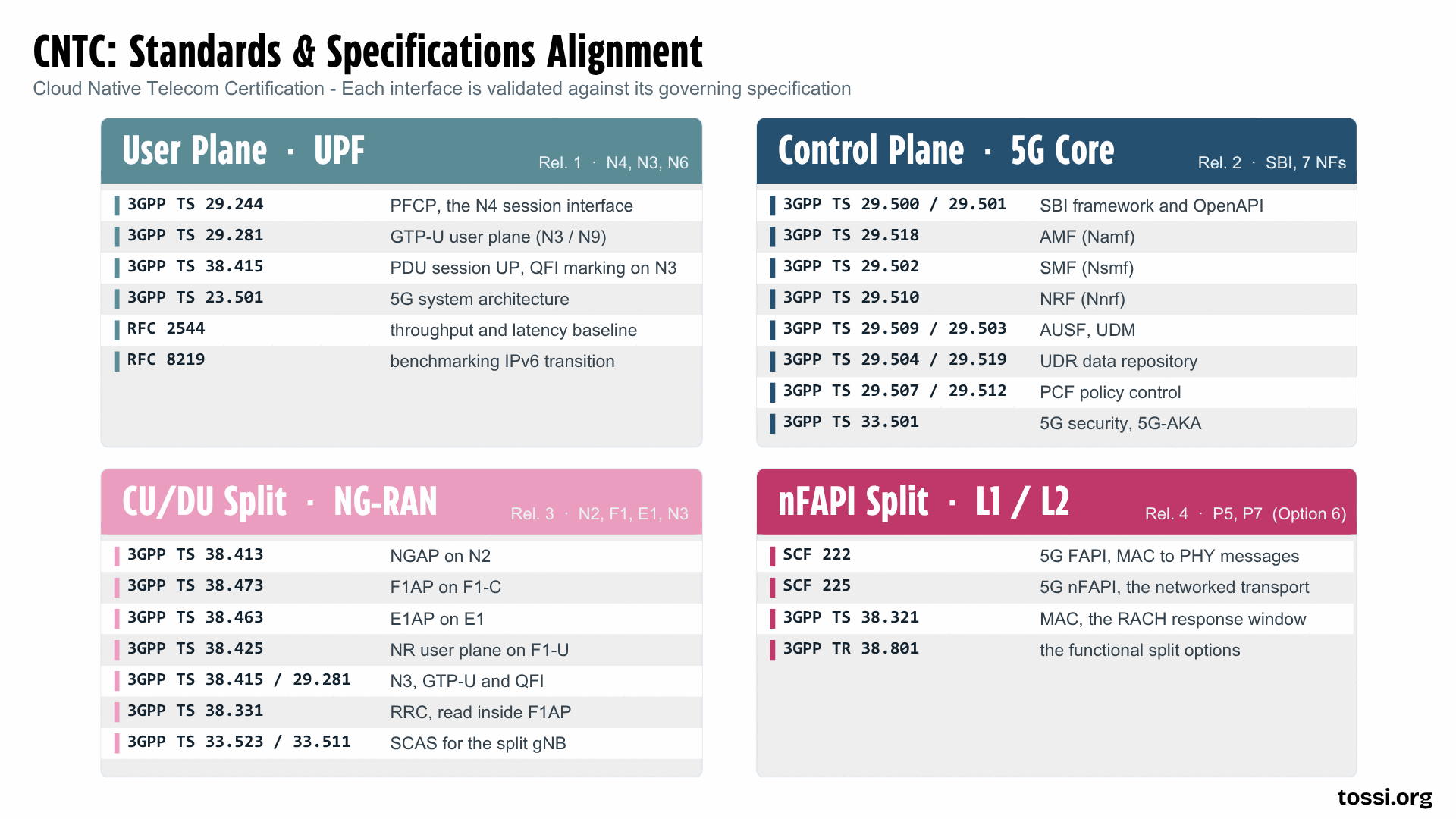
CNTC is built outward from the user plane, one layer at a time. Four releases have shipped. Each has its own page with a full, deployable guide.
| Release | Certification | Subject | Interfaces |
|---|---|---|---|
| Rel. 1 | UPF Certification | User Plane Function | N4 (PFCP), N3 (GTP-U) |
| Rel. 2 | Control-Plane Certification | AMF, SMF, NRF, AUSF, UDM | SBI, N1, N2, N4 |
| Rel. 3 | RAN Certification | Split gNB (CU/DU) | N2, F1-C, E1, F1-U, N3 |
| Rel. 4 | nFAPI Split Certification | L1/L2 split (Option 6) | P5, P7 |
How it works
Every certification is built from two decoupled parts, and only the first one changes from release to release.
- An engine measures. It drives the network function over its real interfaces and records what happened. There are three:
upfbenchfor the user plane,cpbenchfor the control plane, andranbenchfor the RAN. - The
cntcumbrella judges. It reads the serialized results, grades them against a versioned catalog of requirements, and writes the scorecard and certificate. It is shared by all three engines and is not modified when a new engine is added.
Because the two are separate, any past run can be re-graded against a newer catalog without being re-run.
The verdict
Each catalog marks some of its requirements essential. A run is graded against that gate and returns one of three results:
PASS, every essential requirement was exercised and met.FAIL, an essential requirement was exercised and not met.INCOMPLETE, an essential requirement could not be judged on this deployment.
A certificate is issued only on PASS. Individual requirements that could not be judged are recorded as na, together with the reason and what evidence would have been needed. They are never promoted to a pass.
Scope and coverage
Each release ships Level 1: Conformance and Observable Security, which covers everything provable with a spec-compliant peer and observation of the wire. Level 2: Adversarial Robustness and Privileged Interop, which needs a deliberately non-compliant or privileged peer, is drafted as roadmap catalogs and has not shipped.
| Certification | Product classes | Level 1 |
|---|---|---|
| UPF | One subject, conformance and performance | 7 essential |
| Control plane | AMF, SMF, NRF, AUSF, UDM | 44, 26 essential |
| RAN | O-CU-CP, O-CU-UP, O-DU | 58, 30 essential |
| nFAPI split | nFAPI VNF, nFAPI PNF | 41, 23 essential |
Catalogs are versioned per certification, so the version shown on a scorecard belongs to that profile and not to the framework as a whole.
Start here
Each page below is self-contained: prerequisites, install, configuration, a run, and how to read the verdict.