
In our previous article, "India's 5G Decade: Big Intent, Repeated Initiatives, and the Road to 6G Outcomes", we argued that India's telecom journey is not a story of insufficient intent or activity. India has invested in research, testbeds, standards institutions, indigenous telecom programmes and international standardisation. The deeper challenge has always been conversion.
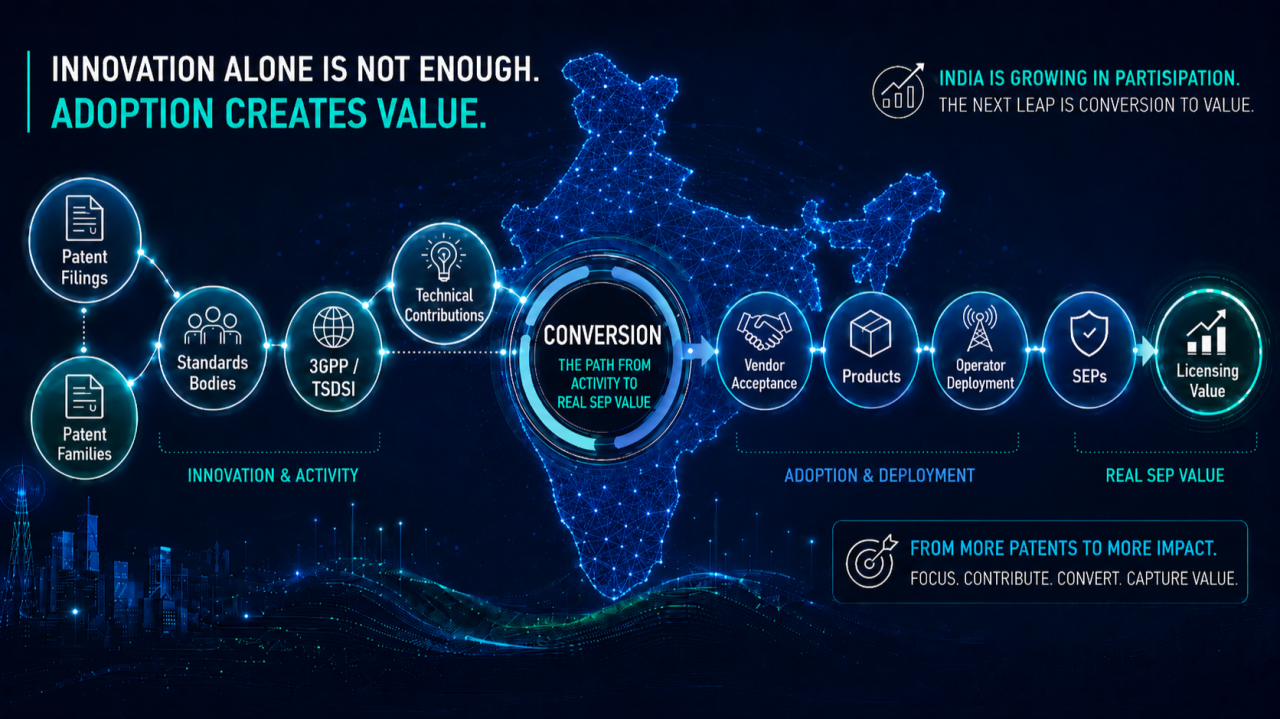
The conversion questions are simple to state and hard to answer. Can research become intellectual property? Can intellectual property become accepted global standards? Can accepted standards become implemented products? Can those products secure operator deployments? And can those deployments create globally valuable, Indian-owned technology?
A recent announcement from the Bharat 6G Alliance reported that B6GA member organisations collectively hold 7,700+ patent filings related to 5G and 6G, 1,787 Indian participants in 3GPP in 2025, and 2,943 technical contributions in 2025.
These are significant numbers. They show that India's participation in telecom research, patenting and global standards development is growing rapidly. But they also create a more important question: what exactly do these numbers measure, and how much of this activity has been converted into genuine Standard-Essential Patent (SEP) value?
1. A patent filing is not the same as a patent, an invention or an SEP
The Bharat 6G Alliance announcement refers specifically to patent filings. It does not state that India has 7,700 granted patents, 7,700 unique inventions, 7,700 active patent families, 7,700 enforceable patents, or 7,700 Standard-Essential Patents.
This distinction is critical. Patent rights are territorial. A single invention may generate an Indian patent application, a Patent Cooperation Treaty application, a United States application, a European application, other national-phase applications, continuation applications, divisional applications, and multiple grants.
One underlying technical invention can therefore produce several patent filings. This is normal patent strategy: major technology companies routinely protect the same invention across multiple jurisdictions. But it means that patent-filing count is not invention count.
A more meaningful conversion chain is: patent filings to unique families, to granted and active claims, to declared SEPs, to independently mapped essential claims, to implemented products, to licensing value.
2. A declared SEP is not automatically a verified SEP
The ETSI IPR database provides public information on patents declared by their owners as essential or potentially essential to ETSI and 3GPP standards. However, ETSI does not independently investigate whether every declared patent is actually essential. Its own published material states that no essentiality investigation or patent search is performed as part of the declaration process.
A declared patent may ultimately cover an optional implementation, one of several permitted alternatives, a design evaluated but not selected, an extra processing step not required by the specification, a vendor-specific optimisation, or a broad technical concept related to the field but not mandated by the standard.
This creates one of the most important distinctions in the SEP ecosystem: research relevance is not standards essentiality. A patent may address the same technical problem examined by 3GPP but claim a solution that 3GPP did not adopt. A contribution may influence a discussion without becoming normative specification text. A feature may be included as an option that a compliant product can avoid. A claim may appear close to the standard while containing one additional limitation that no compliant implementation is required to perform.
SEP value comes from technical necessity, not merely from proximity to the subject matter of the standard.
3. The 17-publication TSDSI declaration dataset
The 7,700+ B6GA patent-filing figure should be distinguished from a much narrower public dataset. The review covered 17 Indian patent publications declared at TSDSI against 4G/5G-related specifications. The declarants included WiSig Networks, IIT Hyderabad and CEWiT/IIT Madras.
These 17 publications are not India's complete telecom patent portfolio. They are not equivalent to the 7,700 filings reported by B6GA members. They represent a defined standards-linked dataset: Indian patent publications publicly identified as having been declared at TSDSI against specified telecom standards.
This definition matters because the expression "Indian SEP" may refer to very different categories: a patent filed in India; a patent granted by the Indian Patent Office; a patent with one or more Indian inventors; a patent owned by the Indian subsidiary of a multinational company; a patent owned by an Indian-controlled company or institution; a patent declared through TSDSI; or a patent arising from publicly funded Indian research. Each definition can produce a different number.
4. What a preliminary claim-level review found
A preliminary independent desk review was conducted on the 17 TSDSI-listed publications. Independent claim 1 of each publication was decomposed into individual limitations and compared with the specification against which the patent had been declared.
The review attempted to distinguish between claims that appeared materially mapped to mandatory standard behaviour; claims that mapped only partially; claims directed to alternative implementations not required by the standard; and claims for which no clear mandatory relationship with the cited specification could be identified.
The preliminary outcome was 4 publications materially mapped, 3 partially mapped, 8 covering alternative implementations, and 2 showing no clearly traceable mandatory relationship with the cited specification.
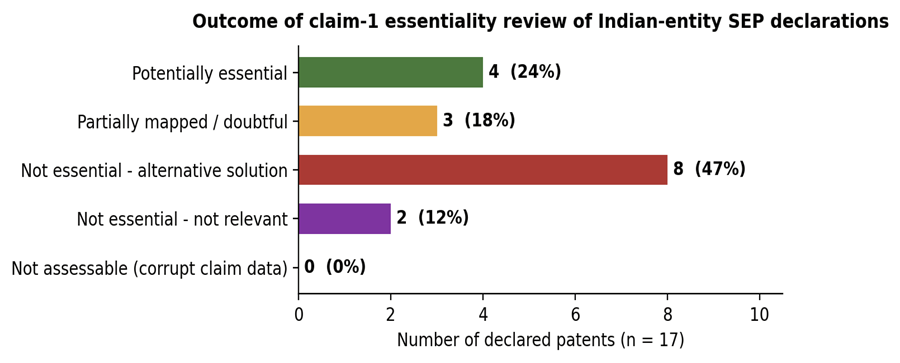
These are preliminary claim-mapping outcomes, not judicial findings of validity, infringement or essentiality.
5. What the individual results suggest
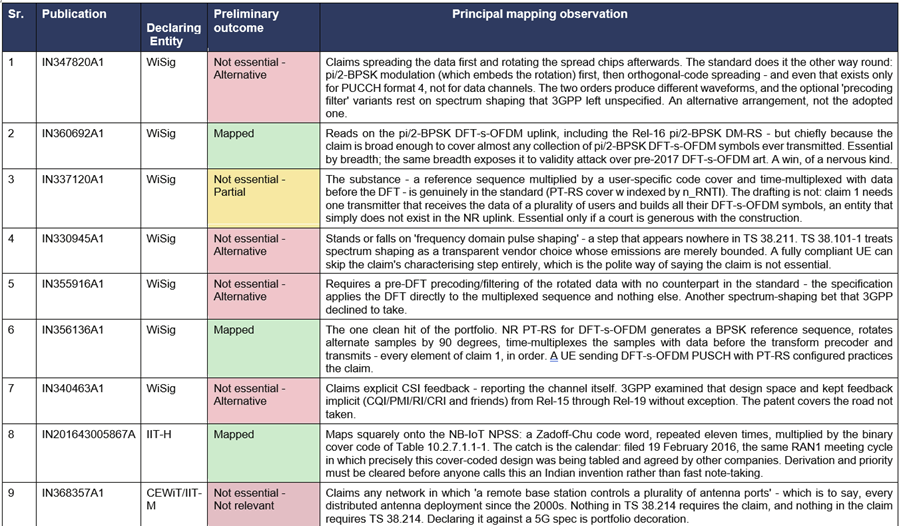
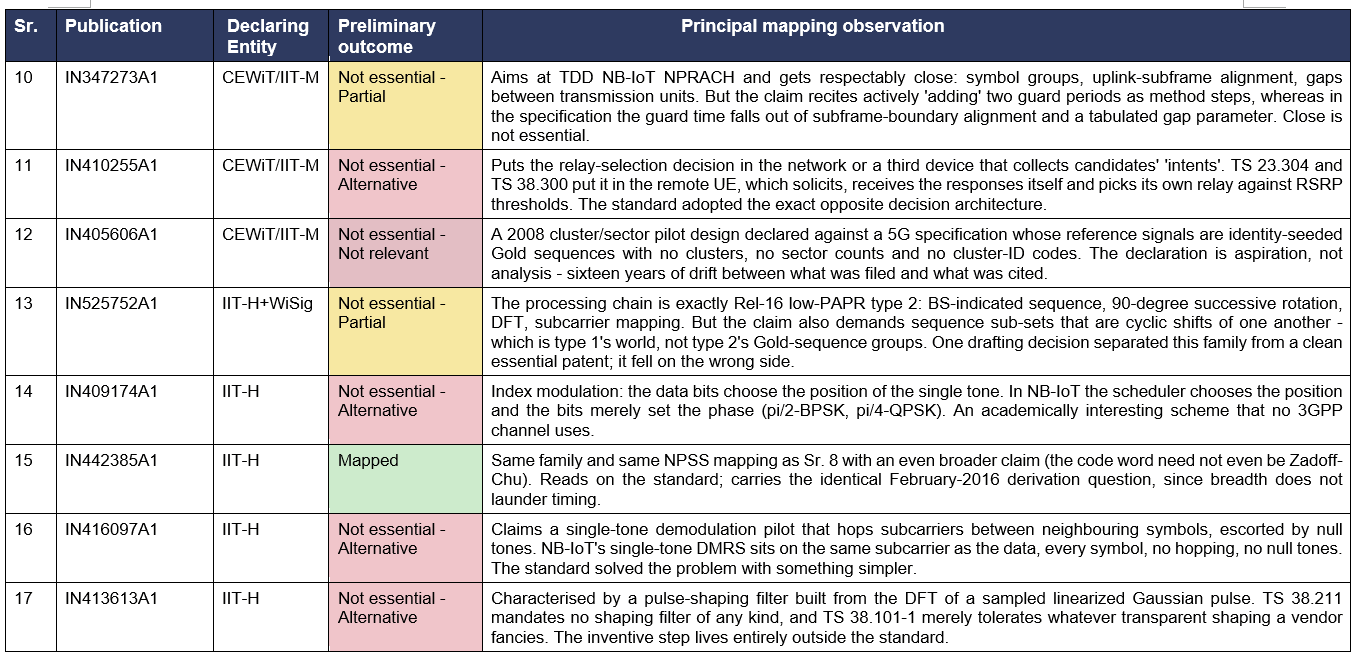
The review identified one particularly credible technical area in the WiSig portfolio involving DFT-s-OFDM uplink reference-signal processing. In one reviewed publication, the claimed processing chain appeared to follow the relevant standardised sequence: generating the reference sequence; rotating alternate samples; time-multiplexing the reference sequence with data; applying transform precoding; and transmitting the resulting waveform.
Other related claims introduced limitations involving pulse shaping, filtering, additional precoding or multi-user transmitter architectures that did not appear to be required by the cited specifications.
This distinction is important. The research area may be the same. The patent titles may appear similar. The inventors may have been addressing the same waveform problem. But one additional non-mandatory limitation can determine whether a compliant implementation necessarily practices the claim.
Several other reviewed publications appeared to claim technically legitimate solutions that were not the solutions required by 3GPP. Examples identified in the review included explicit channel-state feedback rather than the standardised feedback architecture; spectrum-shaping filters left to vendor implementation; index modulation rather than scheduled single-tone transmission; hopping pilot designs rather than the reference-signal design used in the standard; and network-side relay selection rather than the device-side process reflected in the cited specification.
These inventions may remain valuable as academic research, proprietary implementations or future technology options. But a patent directed to an alternative solution is not essential to a standard that selected a different solution.
The partially mapped publications are equally instructive. In these cases, the underlying engineering appeared close to the standard, but the claim language included a limitation that prevented a clean mandatory mapping. That is not merely a research problem. It is a standards-aware patent-drafting problem.
6. The outcome by declaring entity
The preliminary findings were distributed across the declaring institutions rather than being confined to one applicant.
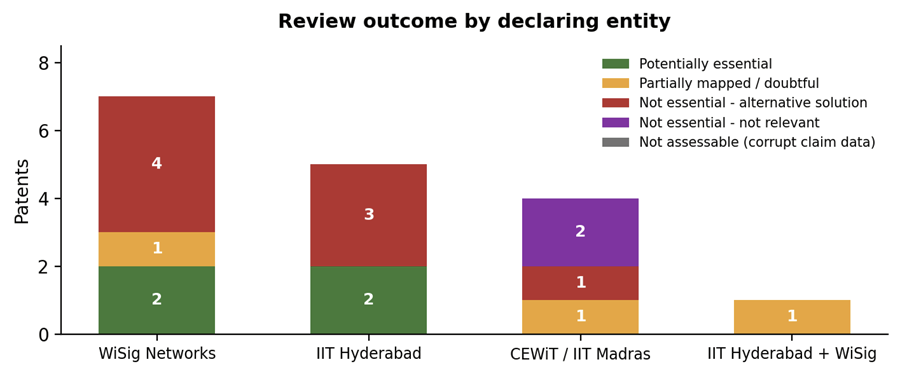
This indicates a broader ecosystem issue involving the timing of patent filings, coordination between research and standards teams, claim drafting, patent-family strategy, identification of mandatory specification text, and post-standardisation claim-chart review.
The message is not that one institution succeeded while another failed. The larger issue is that India has not yet demonstrated a repeatable national process for converting standards-relevant research into consistently defensible SEP claims.
7. Publications are not the same as patent families
Patent-publication counts can also overstate the number of distinct technical inventions. Multiple publications may belong to the same patent family or contain related claim sets arising from the same underlying work.
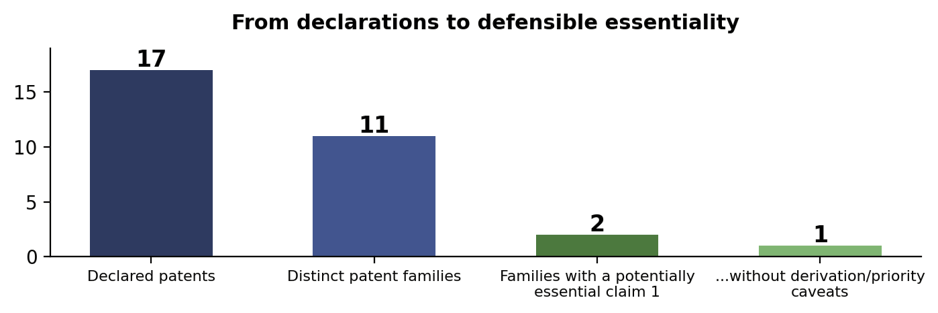
The 17 reviewed publications appeared to consolidate into approximately 11 patent families. Of those families, approximately two appeared to present a materially stronger essentiality case, and one appeared to do so without the same identified priority or provenance concern raised during the preliminary review of the second family.
8. Does the 7,700 figure contradict the 17-publication review?
No. The two numbers measure different things.
The 7,700+ figure represents patent filings related to 5G and 6G reportedly held collectively by Bharat 6G Alliance member organisations. The 17-publication figure represents a narrow dataset of Indian patent publications declared through TSDSI and reviewed against specific telecom standards.
One is an ecosystem-wide patent-filing metric. The other is a standards-declaration dataset. Neither number, by itself, establishes how many verified, Indian-owned SEP families India possesses.
9. The same distinction applies to 3GPP contributions
The increase to 2,943 technical contributions is also encouraging. But contribution volume should not be confused with accepted technology.
A 3GPP contribution may be agreed, approved, noted, revised, merged, postponed, withdrawn, rejected, or submitted mainly to support discussion. It may relate to an original technical proposal, simulation results, performance analysis, a change request, an editorial correction, a liaison statement, implementation feedback, or meeting administration.
Therefore: a contribution is not automatically an accepted invention. An accepted contribution is not automatically normative specification text. Normative specification text is not automatically protected by an Indian-owned patent. A declared patent is not automatically essential.
The strongest evidence of standards ownership is a traceable chain: Indian research, to priority patent filing, to Indian technical contribution, to accepted normative text, to granted international patent family, to mapped mandatory claim, to product implementation, to operator deployment, to licensing value.
India's 6G strategy should measure this complete chain.
10. The central problem remains conversion
India's 5G and 6G ecosystem is becoming larger and more active. The issue is no longer a lack of programmes, participation or ambition. The issue is conversion.
Can India convert patent filings into strong international patent families; standards participation into accepted normative technology; accepted technology into unavoidable patent claims; patent claims into implemented products; products into operator-grade deployments; and deployments into export and licensing value?
That is the difference between participating in a standard and owning part of the standard. It is also consistent with the central lesson from India's 5G experience. India demonstrated that it could introduce national requirements and technical proposals into global standards discussions. TSDSI states that the 5Gi standard was formally merged into the 3GPP Release 17 NR specifications in 2022.
But standards activity cannot be separated from chipset support, device availability, vendor implementation, operator demand, interoperability, deployment economics, and ecosystem scale. For 6G, India should move from a standard-first, deployment-later approach to deployment-backed standards development.
11. Why standards-linked patents become near-misses
Producing a commercially valuable SEP requires several capabilities to operate as one coordinated system: advanced research, patent-landscape analysis, prior-art analysis, standards strategy, product engineering, operator requirements, technical-contribution drafting, standards-aware patent drafting, international prosecution, claim-charting, and licensing strategy.
In many research ecosystems, these activities remain fragmented. Researchers focus on publications. Patent agents focus on filing applications. Standards teams focus on submitting contributions. Government programmes focus on participation and filing statistics. Product teams focus on implementations. Operators focus on cost, performance and deployment risk.
When these activities are disconnected, technically relevant research can become a patent near-miss because the filing happened after public disclosure; the claim included an unnecessary limitation; the standard selected a competing solution; the contribution was not accepted; the granted claim no longer covered the final specification; international protection was incomplete; or no commercial implementation followed.
The established global SEP leaders have industrialised this process. They coordinate research, patents, standards, products, deployments and licensing as one pipeline. India needs the same repeatable institutional discipline.
12. What Bharat 6G Alliance should publish next
The B6GA figures provide an encouraging picture of ecosystem activity. The next step should be a transparent, outcome-oriented scorecard.
For the 7,700+ patent filings, disclose the number of unique priority families; domestic and foreign applications; PCT and national-phase filings; granted, pending, abandoned and expired patents; Indian-owned and foreign-owned rights; ownership by Indian-controlled entities; 5G, 5G-Advanced and 6G classifications; applicant-wise distribution; technology-area distribution; and patents associated with standards contributions.
For the 2,943 technical contributions, disclose total submitted contributions; original technical proposals; revisions and resubmissions; agreed or approved contributions; merged contributions; rejected or withdrawn contributions; contributions that changed normative specification text; and corresponding patent families.
For SEP performance, disclose unique declared patent families; mandatory specification clauses mapped; granted and active claims; independent essentiality assessments; international jurisdiction coverage; commercial implementations; executed licences; licensing revenue; and product or operator deployments.
This would not weaken the B6GA announcement. It would transform the announcement from an activity statement into a credible measure of India's standards and intellectual-property position.
13. What India should target for 6G
India does not need to imitate every patent strategy of the largest global SEP owners. It should focus on areas where Indian requirements and technical capabilities can produce globally relevant solutions.
- Rural and extreme coverage
- Energy-efficient RAN
- AI-native network control
- AI-RAN interoperability
- Integrated sensing and communications
- Non-terrestrial networks
- Affordable private networks
- Quantum-safe telecom security
- Trusted and interoperable Open RAN
- Resilient communications
- Spectrum efficiency
- Low-cost network architectures
For each priority area, the programme should integrate early-stage research; global patent-landscape analysis; filing before public disclosure; coordinated 3GPP and ITU contribution strategies; standards-aware patent drafting; international patent-family development; reference implementations; open interoperability testing; operator trials; chipset and OEM alignment; commercial deployment; and licensing strategy.
The principal target should not be: how many patents did India file? The target should be: how many globally relevant technologies did India create, protect, standardise, implement, deploy and commercialise?
14. Final takeaway
India's 7,700+ patent filings and rapidly increasing 3GPP participation are not empty achievements. They show that the Indian telecom ecosystem is becoming larger, more active and more internationally engaged. This is a necessary foundation for 6G leadership. But it remains a foundation.
A patent filing that does not become a granted and useful family remains an application. A technical contribution that does not influence the specification remains participation. A declared patent that is not required by the standard is not necessarily an SEP. A standardised feature that is not implemented remains specification text. A patent that is not deployed, licensed or used in products has limited strategic value.
India's next telecom transition must therefore be: from patent-filing volume to strong patent families; from contribution volume to accepted normative technology; from declared essentiality to independently mapped claims; from standards participation to standards ownership; and from publicly funded research to globally deployed products.
In our earlier analysis of India's 5G decade, the central conclusion was that India's challenge was not intent. It was conversion. The new B6GA numbers show that India has expanded the input side of the innovation pipeline. The next question is whether India can now improve the output.
India is already in the room where global telecom standards are written. The real test of 6G leadership is whether India can consistently create technologies that the standards body selects, the specification mandates, the patent protects, the vendor implements, the operator deploys and the global market licenses.
That is the difference between counting activity and creating strategic technology value. That is the road from 7,700 filings to real SEP leadership.
Sources and methodology
This article draws on the Ministry of Communications announcement concerning the Bharat 6G Alliance, dated 28 July 2026; TSDSI's announcement concerning the merger of 5Gi into 3GPP Release 17; the earlier article, "India's 5G Decade: Big Intent, Repeated Initiatives, and the Road to 6G Outcomes"; and an independent preliminary claim-1 desk review of the 17 TSDSI-listed patent publications by Dipesh Kumar Gautam.
The purpose of this article is not to target or undermine any company, academic institution, standards body, government organisation or individual. Its purpose is to encourage clearer definitions, independent verification and outcome-oriented measurement so that India can convert its growing 5G/6G research and standards participation into globally competitive products, intellectual property, deployments and licensing value.