
Open RAN's biggest challenge isn't open interfaces, it's interoperability. We demonstrate a major milestone: OAI Layer 1 (v2.4) and OCUDU Layer 2 (v26.04) interoperating through xFAPI Release 2.2, with no source-code modifications to either project. All the integration logic lives inside xFAPI.
For nearly a decade, Open RAN has promised a future built on openness, vendor neutrality, and deployment flexibility. Operators should be able to select the best components from different vendors and open-source projects, integrate them seamlessly, and deploy networks optimized for their unique requirements. Yet despite the progress made in standardization and interface definitions, one fundamental challenge remains: interoperability.
Open interfaces alone do not create interoperable systems. Across the Open RAN ecosystem, multiple implementations follow the same specifications while evolving independently in architecture, transport mechanisms, deployment models, and internal message handling. While standards define what should be exchanged, they do not eliminate the practical challenges of integrating independently developed software stacks. This gap between specification compliance and real-world interoperability is where many deployments encounter complexity.
The true measure of Open RAN success is not whether interfaces are defined on paper. It is whether independently developed components can work together in real deployments. At TOSSI (Telecom Open Source System Integrator), our mission is to bridge that gap by bringing together open-source telecom projects and demonstrating practical interoperability across the ecosystem.
A Significant Step Toward Truly Open Open RAN
This demonstration brings together three major open-source initiatives: OAI Layer 1 (v2.4), xFAPI (v2.2), and OCUDU Layer 2 (v26.04).
The key achievement: OAI Layer 1 and OCUDU Layer 2 successfully interoperated through xFAPI Release 2.2 without requiring source code modifications to either project. This validates one of Open RAN's core principles: independently developed components can be integrated while preserving their native implementations and maintaining compatibility with upstream releases.
Rather than forcing adaptations into OAI or OCUDU, all interoperability logic resides within xFAPI itself. The result is a clean, modular, and reusable integration framework that enables interoperability without compromising project independence.
Building on the Foundation of xFAPI Release 2.1
Major interoperability milestones are rarely achieved in a single step. The foundation for this work was established through xFAPI Release 2.1, where coRAN LABS introduced OCUDU split-mode support, xSM shared-memory integration, and enhanced transport abstraction capabilities. These demonstrated how xFAPI could bridge implementation differences while remaining transparent to the underlying software stacks.
Release 2.2 builds directly on that foundation by extending interoperability beyond a single ecosystem and enabling integration between two independently developed Open RAN projects. This evolution transforms xFAPI from an integration framework into an interoperability layer capable of connecting diverse Open RAN implementations.
OAI Layer 1 Meets OCUDU Layer 2
One of Open RAN's most frequently discussed benefits is the ability to mix and match components. Achieving this in practice is often far more difficult than it appears. Different projects may implement specifications correctly while adopting entirely different approaches for transport mechanisms, timing models, message handling, buffer management, deployment architectures, and internal optimization techniques. These differences frequently create integration challenges that require substantial engineering effort. This demonstration proves that those barriers can be overcome.
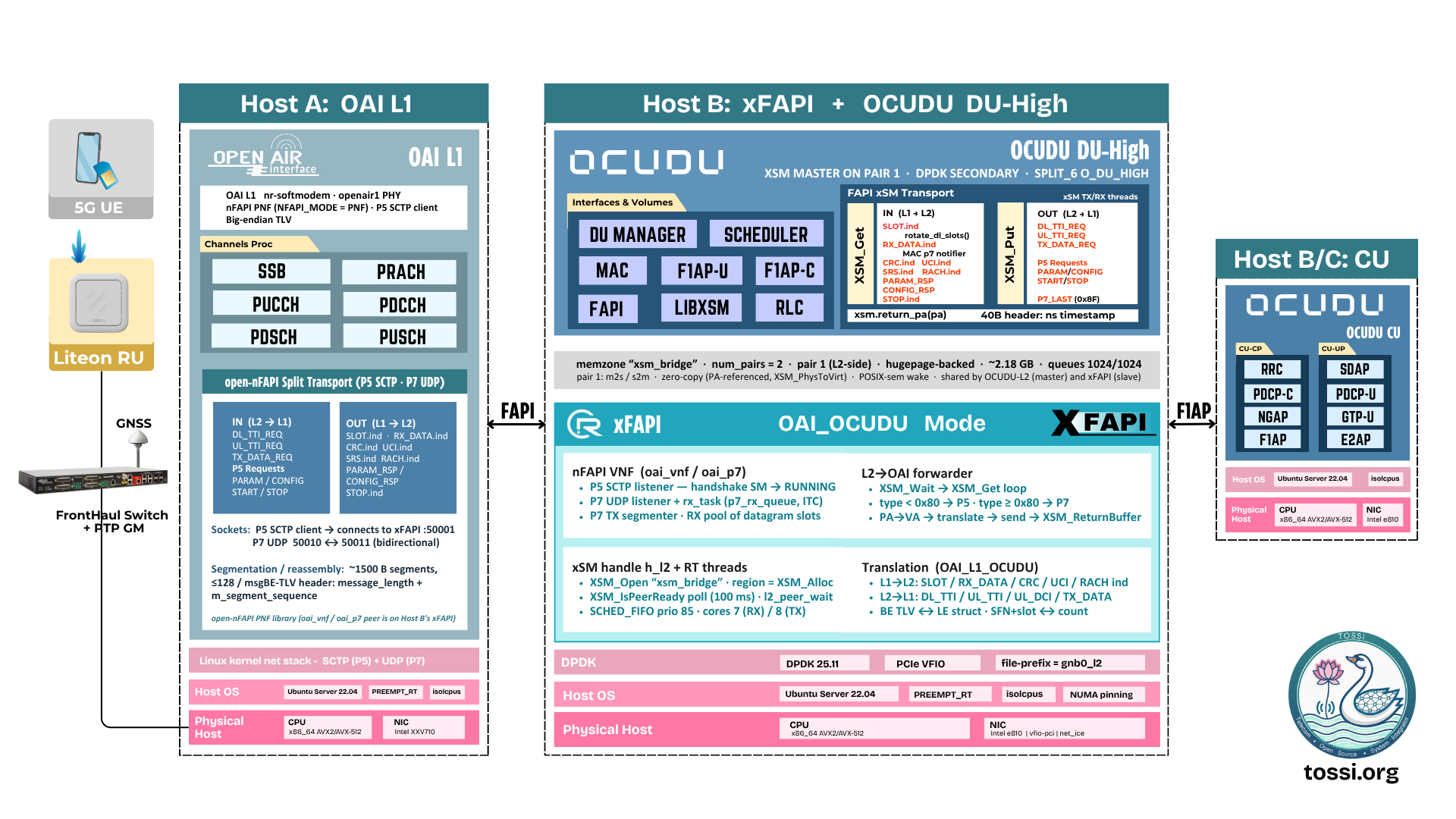
The integrated system consists of:
- OAI Layer 1 (PHY) — the physical layer implementation and radio processing capabilities.
- OCUDU Layer 2 — MAC, scheduler, and higher-layer functionality from the Linux Foundation OCUDU project.
- xFAPI Release 2.2 — the interoperability layer that enables both components to communicate while preserving their native behavior.
Neither OAI nor OCUDU was modified for this integration. Instead, xFAPI performs the required translation and adaptation transparently between the two systems, which significantly reduces integration complexity while preserving upstream compatibility.
How the Integration Works
The architecture demonstrates how interoperability can be achieved without imposing implementation constraints on participating projects. OAI Layer 1 uses an nFAPI socket-based transport model. OCUDU Layer 2 uses an xSM shared-memory transport model. xFAPI performs real-time translation between FAPI implementations, transport mechanisms, message formats, and runtime expectations.
The result is a seamless interoperability layer that allows both systems to operate together as if they were originally designed for each other. Neither stack is aware of the adaptation occurring underneath. This approach preserves flexibility while enabling practical multi-project deployments.
Why This Matters for the Open RAN Industry
The industry often focuses on standards, specifications, and interface definitions. These are essential, but interoperability is where Open RAN either succeeds or fails. Operators ultimately deploy systems, not specifications. They need confidence that components from different vendors, projects, and ecosystems can work together without costly custom integration efforts.
Demonstrations such as this provide practical evidence that open-source Open RAN projects can interoperate, that independent innovation does not have to create ecosystem fragmentation, and that vendor neutrality can be achieved without sacrificing functionality. Most importantly, it shows that interoperability can be achieved while preserving project autonomy. No project needs to compromise its roadmap, architecture, or development velocity to participate in a broader ecosystem.
The Road to AI-RAN
The importance of interoperability becomes even greater as the industry moves toward AI-RAN and accelerated Layer 1 architectures. Emerging technologies such as GPU-accelerated PHY processing, NVIDIA Aerial, AI-assisted scheduling, AI-native radio optimization, and heterogeneous compute environments are introducing entirely new deployment models. These require a level of modularity and flexibility that traditional tightly coupled architectures cannot easily provide.
Interoperability frameworks such as xFAPI become critical enablers for this future. By abstracting implementation-specific details and providing a common integration layer, xFAPI allows Layer 1 implementations to evolve independently while remaining compatible with existing Layer 2 deployments. This creates a practical pathway toward AI-RAN architectures, accelerated PHY deployments, GPU-native radio processing, cloud-native RAN deployments, and heterogeneous compute infrastructures. The future of RAN innovation depends on the ability to combine best-of-breed technologies, and interoperability is what makes that possible.
Beyond Integration: Building an Ecosystem
This demonstration is not simply about connecting three software projects. It represents a broader vision for the Open RAN ecosystem: a vision where innovation happens independently, projects maintain architectural freedom, components remain interchangeable, integration complexity is minimized, and operators gain deployment flexibility.
Open RAN reaches its full potential when interoperability becomes a reality rather than an aspiration. The goal is not to create a single implementation. The goal is to create an ecosystem where many implementations can coexist and work together. That is the true promise of openness.
Community-Driven Innovation in Action
This work reflects the mission of TOSSI: Telecom Open Source System Integrator. Our objective is to bring together open-source telecom projects, validate interoperability, and showcase deployable end-to-end systems built from community-driven technologies. By integrating OAI, xFAPI, and OCUDU into a functioning Open RAN stack, we demonstrate how open-source innovation can move beyond individual projects and become part of a larger interoperable ecosystem.
This is more than a demonstration of software integration. It is a demonstration of what the future of Open RAN can look like: a future where interoperability moves beyond specifications and becomes a practical reality, where operators are free to choose the technologies that best meet their needs, and where innovation is accelerated by openness rather than constrained by integration complexity. This is what Truly Open ORAN looks like.
Useful Links
Watch the end-to-end demo on our Videos page.